
- History and Scope of Microbiology
HISTORY & SCOPE OF MICROBIOLOGY
Introduction:
The branch of biology dealing with the study of microorganisms is called Microbiology. Micro refers to things that are too tiny to be seen by the naked eye and biology refers to study of living things. Bacteria, fungi, algae, protozoa, etc resemble one other in their tiny size and simplicity of structure and organization and are called microorganisms or microbes.
Brief History of Microbiology:
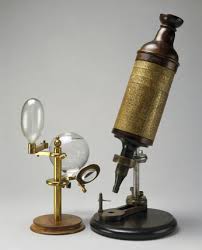
The study of micro-organisms began with the invention of first microscopes in the 1600’s. Robert Hooke, the English Scientist constructed a simple microscope (1.1) and published a book with many illustrations of a previously unseen world of biological materials in 1665.
| 1.2. Simple microscope made by Anton van Leeuwenhoek |
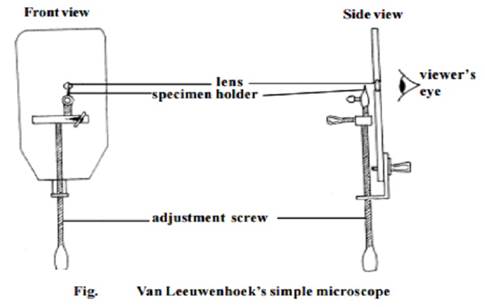
Figure 1.1. Robert Hooke’s Microscope
The Dutch merchant Anton van Leeuwenhoek observed minute forms of life in droplets of pond, rain, and seawater using a his simple microscope in 1674. Anton van Leeuwenhoek was the first to see and describe bacteria and was the first person who discovered micro-organisms which he called animalcules. Anton van Leeuwenhoek has been called the father of microbiology.
Theory of Spontaneous Generation
It is the belief that living organisms could originate from non-living or decomposing matter, which was accepted by many people. One of the first people to explain about this concept was Aristotle who in 4 B.C. stated that flies, worms and small animalcules arose from decaying matter. Jan baptista Van Helmont believed that non-living things can give rise to living things.
The Italian Physician Francesco Redi for the first time challenged the spontaneous generation theory by demonstrating the development of maggots from the eggs of flies. He placed a piece of meat in three jars, one he left open, one he corked tightly and the third he covered with a fine mesh gauze. Maggots only appeared in the open container, no matter how long he left the jars. No maggots appeared in the other jars.

Figure 1.3. Francesco Redi’s Experiment
Louis Pasteur (who is called the father of modern microbiology),by his experiments using swan neck flask disproved the Spontaneous Generation theory finally in 1859. Pasteur first drew the necks of glass flasks out so that they remained open to the air, but were bent so that air could only enter by a curved path. He then added broth and boiled it to destroy contaminating microbes. These flasks were then incubated and observed for months.
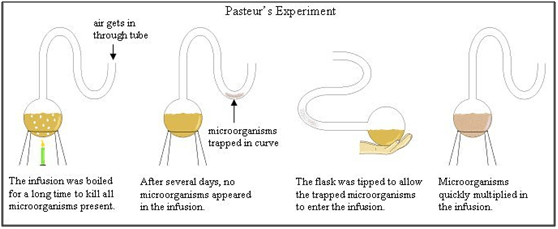
Figure 1.4. Experiment in swan neck flask done by Louis Pasteur
In 1865 the silk industry in France was threatened by disease that was killing the silkworm. He found the parasite that was infecting the worms. He was the one who led to the most important single medical discovery of all time, the ‘germ theory’ of disease.
He developed the vaccines for anthrax and rabies. He developed a method by which if one had to heat the wine to a point where its flavour was unaffected, but the harmful microbes were killed it wouldn’t spoil. This method is known as Pasteurization.
Robert Koch another microbiologist became interested in anthrax, a common disease of both the farmers and their animals in his rural practice. Koch saw a large bacterium in the blood of anthrax victims. He reasoned that it might be the agent of the disease.
Robert Koch purified anthrax bacterium and then inoculated the purified bacteria into healthy animals and produced the classical clinical disease. When he examined the blood of the inoculated animals he was able to re-isolate the same bacterium. He repeated the isolation, infection and disease cycle until he was certain he had found the agent of anthrax. His studies, in combination of those of Pasteur’s, established the GERM THEORY of disease.
His procedure for defining the agent of any disease, called Koch’s postulates,
- isolate the suspected agent from a disease victim.
- grow the agent in pure culture.
- infect a healthy host and cause to produces the classical clinical disease
- isolate the same organism from the new victim.
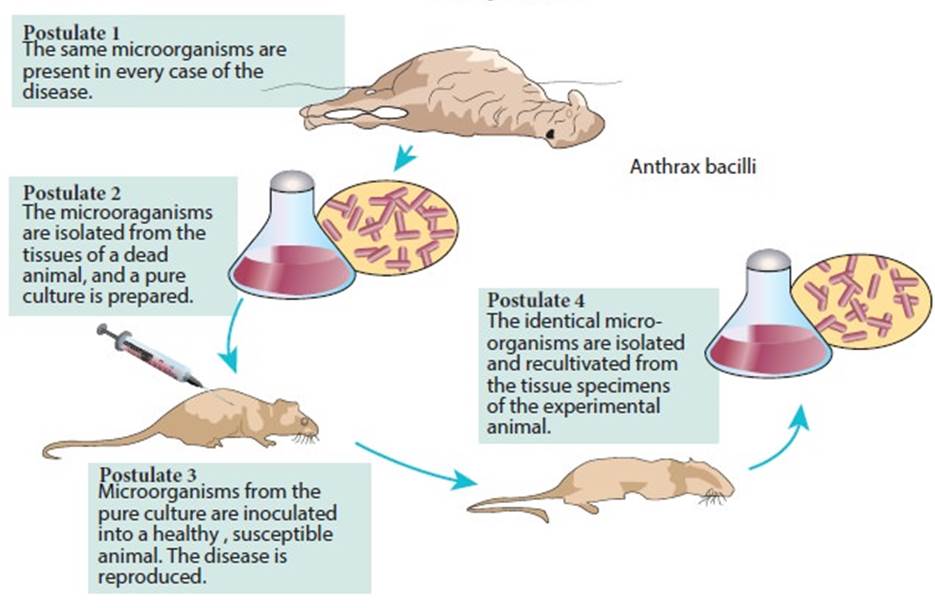
Figure 1.5. Experiment done by Louis Pasteur
He also isolated the bacilli of tuberculosis, cholera. His contributions also include the sterile culture techniques, pure culture techniques, the use of petri plates, inoculation needles, solid medium, the use of agar and gelatin to produce a solid surface and staining procedures.
In addition Edward Jenner work in this field developed the vaccine for small pox. Joseph Lister will always be remembered for developing the antiseptic techniques.
Microorganisms
Many microorganisms are unicellular, some makes up a loose aggregates of independent cells. Microorganisms perform the same fundamental activities as higher organisms. As majority of microorganisms are small they can be only seen with the help of microscope or even smaller organisms such as viruses with the help of electron microscope only. They are found almost every habitat, e.g. soil, water, air, animals, plants etc. They are the foundation of all life on earth.
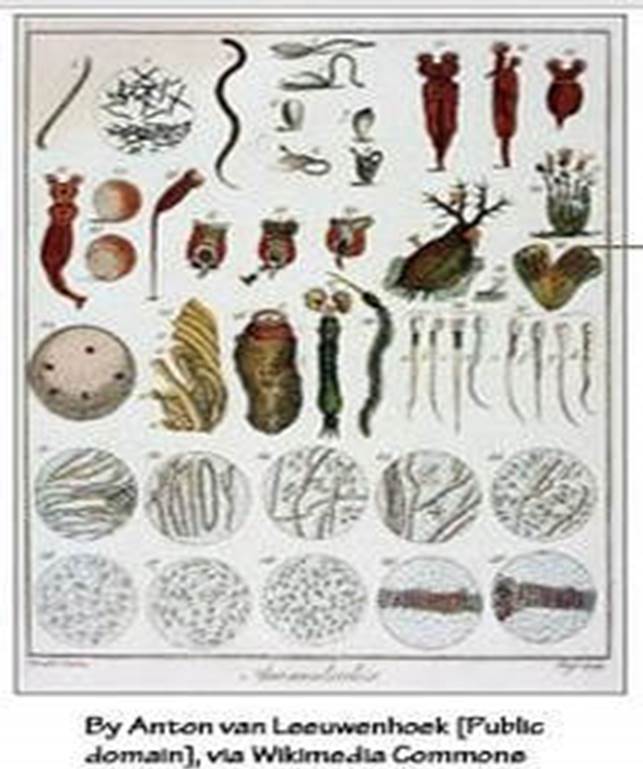
Fig. 1.6 Various types of Microorganisms as observed by Leeuwenhoek
Microorganisms includes:
1. Bacteria – simple, single cell
2. Fungi – single & multi cell forms – yeast, filamentous moulds,
complex fungi
3. Protists – single cell, some multicellular – algae, protozoans, slime
moulds
- Viruses – acellular, intracellular parasites
SIZES OF MICRO-ORGANISMS:
Viruses: 0.02 to 0.2 microns
Bacteria: 0.2 to 5 microns
Yeast Cells: 8 to 10 microns
Fungal cells: 20 to 40 microns
Note: One micron is a millionth of a metre or 1/1,000,000 of a metre
= 1/1000 of a millimetre, i.e., 1×10 3
Importance of Microbiology
Microorganisms play important role both in human activities and the web (network) of life on Earth. In the absence of microrganims for example the higher life forms would never risen and survived. Indeed, the very oxygen we breathe in is the result of past microbial activity. Microbes influence the quality of human life by the following ways
- Maintain the balance of chemical elements in nature.
- Breakdown all the dead organic matter.
- Recycle carbon, nitrogen, sulfur, phosphorus and other elements.
- Some cause infectious diseases by either invading the body systems or produce powerful toxins that interfere with body physiology.
- Viruses inflict damage by replicating themselves within cells.
Humans, plants and animals are intimately tied to microbial activity for the recycling of key nutrients and for degrading organic matter. Therefore microorganisms are important for the support and maintenance of life on earth. Hence the science of microbiology is the foundation of all biological sciences.
Branches of Microbiology
A brief look at each of the various fields of microbiology may give some understanding of how microorganisms influence our lives:
- Medical Microbiology:
It deals with microorganisms that cause diseases in humans, animals and many plants. In medical microbiology, the microorganisms that cause illness/ diseases are called pathogens. The term disease refers to a process or event that results in illness or harm to living things.
- Food and Dairy Microbiology:
When microorganisms enter food they may cause to spoil, make it dangerous to eat, or change to another form which is still acceptable as a food. In this field of microbiology the scientists find out how the microorganisms enter the food, what action it has and how to control the growth of microorganisms in food. The idea of preservation of food is based on preventing microbial growth e.g., in Pasteurization.
- Water and Waste Water Microbiology:
Water in the environment commonly contains microorganisms. The kinds of microorganisms and their method of entering are of great concern since many waterborne microorganisms can cause human diseases. The ultimate source of water is rain. The water moves over the surface of the ground as river, streams and falaj, or enters the ground as ground water. Microorganisms and chemicals may enter water from the air as water passes through it as well as from untreated or poorly treated sewage being dumped in to body of water. Drinking water must be cleared of harmful bacteria and other microorganisms to control diseases and prevent contamination of the equipment.
- Soil and Agriculture Microbiology:
Soil contains many types of microorganisms. Bacteria, algae and fungi are commonly found in rich, fertile soil. Microorganisms are responsible for the decomposition and decay of dead plants and animals. The recycling of materials through decay activities in the soil is vital to all life.
- Industrial Microbiology:
It involves the large scale production of particular microorganisms. It is also the by-product of the growth and activities of microorganisms which are most useful. Such activities includes e.g., enzymes, amino acids, antibiotics alcohol and organic acids.
- Environmental Microbiology:
Microorganisms play major roles in energy production. Natural gas (methane) is a product of bacterial activity, arising from the metabolism of methanogenic microorganisms. Microorganisms can also be used to help clean up pollution created by human activities i.e., Bioremediation. Biotechnology, genetic engineering (the artificial manipulation of genes and their products) are also included in it.
Branches of microbiology fall into two categories namely Pure branches and Applied branches.
Pure branches of Biology:
1. Bacteriology – study of bacteria.
2. Mycology – study of fungi.
3. Nematology – study of nematodes.
4. Phycology – study of algae.
5. Protozoology – study of protozoa.
6. Virology – study of viruses.
7. Parasitology – study of parasites.
8. Microbial cytology – study of microscopic and submicroscopic
details of microbial cells.
9. Microbial ecology – study of relationship between
microorganisms and their environment.
10. Microbial systematics – study of diversity and genetic relationship
of microorganisms.
Applied branches
- Aero-microbiology: study of airborne microorganism.
- Astro-microbiology/Exomicrobiology: study of microbes in the outer space.
- Agricultural Microbiology: study of microbes relevant in agriculture.
- Environmental Microbiology: study of microbes in the natural environments.
- Food Microbiology: study of microbes used in food production and that damage food.
- Medical Microbiology: study of pathogenic microbes.
- Water microbiology: study of microbes found in water.
- Pharmaceutical Microbiology – Use of microbes in the development of antibiotics, vaccines, and drugs.
- Veterinary Microbiology – Study of microbes affecting animal health and zoonotic diseases.
- Microbial Biotechnology – Genetic engineering of microbes for applications in medicine, agriculture, and industry.

 Explore the World of Life Sciences