
11. Biodiversity
The term “biodiversity” refers to the vast variety of all forms of life on Earth, including plants, animals, microorganisms, and their ecosystems.
Three different levels of Biodiversity:
Genetic Diversity: The variety of genes within a species, which allows populations to adapt to changing environments and resist diseases. (the genetic variation within each species).
Species Diversity: The number and abundance of species in a particular area, providing balance in ecosystems.
Ecosystem Diversity: The number and range of different ecosystems and habitats. The variety of ecosystems, such as forests, grasslands, wetlands, and coral reefs, each providing essential services like carbon storage and water purification.
🔹 Importance of Biodiversity:
It helps maintaining ecosystem stability and resilience
- Biodiversity furnishes many Ecosystem Services:
- Provisioning Services: Biodiversity provides resources like food, medicine, and raw materials.
- Regulating Services: It helps regulate climate, control pests, and purify water.
- Cultural Services: Biodiversity enriches cultural, spiritual, and recreational experiences.
- Supporting Services: Essential processes like soil formation, photosynthesis, and nutrient cycling depend on biodiversity.
- Economic Value:
- Many industries rely on biodiversity, including agriculture, pharmaceuticals, and tourism.
- Ecological Stability:
- Diverse ecosystems are more resilient to environmental changes and natural disasters.
- Scientific and Educational Value:
- Biodiversity serves as a resource for scientific discovery and education.
- It provides diverse genetic resources to improve crop yield and resistance to diseases.
🔹 Threats to Biodiversity:
❌ Habitat destruction/fragmentation (deforestation, urbanization)
❌ Environmental Pollution (air, water, soil)
❌ Climate change (global warming, rising sea levels)
❌ Over-exploitation (hunting, fishing, logging)
❌ Invasive species (outcompeting native species)
🔹 Conservation Methods:
✔ In Situ Conservation – Protecting species in their natural habitat (e.g., national parks, wildlife reserves).
✔ Ex Situ Conservation – Preserving species outside their habitat (e.g., zoos, seed banks, captive breeding programs).
✔ Legislation & Policies – International treaties like CITES (Convention on International Trade in Endangered Species).
12 Exchange Surfaces & Breathing
Exchange surfaces allow the efficient movement of gases and nutrients between an organism and its environment. In humans, this involves lungs, while in plants, it includes stomata.
Features of an efficient Exchange Surface:
✔ Large Surface Area – Maximizes absorption (e.g., alveoli in lungs).
✔ Thin Membranes – Short diffusion distance for gases.
✔ Moist Surfaces – Helps dissolve gases for exchange.
✔ Rich Blood Supply – Maintains concentration gradients (e.g., capillaries).
🔹 Gas Exchange in Humans (Lungs & Alveoli):
✅ Breathing [External Respiration] Oxygen Diffusion – Air enters alveoli → Oxygen diffuses into blood.
✅ Carbon Dioxide Removal – CO₂ diffuses out of blood → Exhaled.
✅ Role of Hemoglobin – Binds oxygen for transport to tissues.
🔹 Breathing Mechanism:
✔ Inhalation – Diaphragm contracts, ribs expand,Thoracic cavity increases,Lung volume increases, air lungs fill with air.
✔ Exhalation – Diaphragm relaxes, ribs lower, air is expelled.
🔹 Gas Exchange in Other Organisms:
🦠 Single-Celled Organisms – Use direct diffusion.
🐟 Fish – Use gills for gas exchange in water.
🌱 Plants – Use stomata for CO₂ and O₂ exchange during photosynthesis.
🔹 Diseases Affecting Respiratory system:
❌ Asthma – Narrowing down of airways leading to difficulty in breathing.
❌ Emphysema – Breakdown of alveolar walls leading to low oxygen intake.
❌ Cystic Fibrosis – Thick mucus blocks airways.
🔹Practical Applications
✔ Medical Science – Oxygen therapy, artificial ventilators.
✔ Sports Science – Improving lung efficiency in athletes.
✔ Environmental Studies – Impact of pollution on respiration.
✔ Biotechnology – Lung tissue engineering for transplants.
13. Transport in Animals
Transport in animals refers to the movement of essential substances (oxygen, nutrients, hormones, and waste) through the circulatory system.
🔹 Types of Circulatory Systems:
✔ Open Circulatory System – Found in insects; organs get directly in the hemolymph(blood).
✔ Closed Circulatory System – Found in vertebrates; blood is enclosed within vessels.
✔ Single Circulatory System – Found in fish; blood passes through the heart once in one cycle.
✔ Double Circulatory System – Found in mammals, blood passes through the heart twice per
cycle (pulmonary and systemic circulation).
🔹 Human Circulatory System:
✅ Heart – Muscular pump responsible for circulating blood.
✅ Blood Vessels – Include:
– Arteries – carry oxygenated blood away from the heart.
– Veins – carry de-oxygenated blood toward the heart.
– Capillaries – Microscopic vessels for gas and nutrient exchange.
✅ Blood Composition:
– Red Blood Cells (RBCs) – Carry oxygen using hemoglobin.
– White Blood Cells (WBCs) – Defend against infection.
– Platelets – Help with blood clotting.
– Plasma – Transports nutrients, hormones, and waste.
🔹 Circulatory Pathways:
✔ Pulmonary Circulation – Transports blood between the heart and lungs for gas exchange.
✔ Systemic Circulation – Moves oxygenated blood to the body and returns deoxygenated blood to the heart.
🔹 Diseases Affecting Circulation:
❌ Coronary Heart Disease (CHD) – Narrowing of coronary arteries due to plaque buildup.
❌ Hypertension – High blood pressure increases strain on the heart.
❌ Stroke – Blockage or rupture of blood vessels in the brain.
🔹 Applications:
✔ Medicine & Surgery – Heart transplants, artificial pacemakers.
✔ Sports Science – Understanding cardiovascular endurance in athletes.
✔ Biotechnology – Artificial blood, gene therapy for heart diseases.
✔ Public Health – Strategies for preventing heart disease through diet and exercise.
14. Transport in Plants
Plants need efficient transport systems to move water, minerals, and sugars to different parts of the plant. This is achieved through the vascular/transport tissues such as xylem and phloem.

🔹 Xylem – Water Transport
✔ Function: Transports water and minerals from roots to leaves.
✔ Structure: Made of dead, hollow cells for efficient flow.
✔ Mechanisms of Water transport:
– Root Pressure – Upward push of water from the roots.
– Capillary Action – Water moves through xylem vessels & tracheids, the narrow tubes.
– Cohesion-Tension [Transpiration -Pull theory] – Water molecules stick together and are pulled up by transpiration.
🔹 Phloem – Sugar Transport (Translocation)
✔ Function: Moves sugars (produced in photosynthesis) from source (leaves) to sink
Structure: Made of living sieve tube elements supported by companion cells.
✔ Mechanisms involved in Translocation
– Mass Flow Hypothesis – Sugars move by pressure differences in phloem.
🔹 Transpiration – Water Loss from Leaves.
✔ Loss of excess water in the form of vapor from the plant body through stomata in leaves.
✔ Factors Affecting Rate of Transpiration:
– Temperature
– Humidity
– Wind
– Light Intensity
🔹 Adaptations to Reduce Water Loss:
🌵 Xerophytes (Desert plants) – Thick cuticles, sunken stomata.
🌿 Hydrophytes (Water plants) – Large air spaces in tissues.
🔹 Applications
✔ Agriculture – Understanding water transport helps improve irrigation techniques.
✔ Botany & Forestry – Managing plant health for sustainable ecosystems.
✔ Biotechnology – Genetic modification for drought-resistant crops.
✔ Climate Science – Studying plant responses to environmental changes.
16. Photosynthesis
Photosynthesis is the process by which Chlorophyllated cells (plants, algae, and some bacteria) convert light energy into chemical energy (glucose), using carbon dioxide and water.
🔹 Equation showing (reduction and oxidation reactions) in photosynthesis.
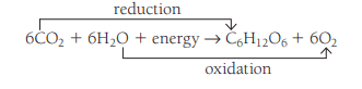
(Carbon dioxide + Water + Light → Glucose + Oxygen)
🔹 Stages of Photosynthesis:
Photosynthesis occurs in two main stages [Light phase & Dark Phase] within the chloroplast:

1️. Light Phase [Light-Dependent Reactions (Occurs in Thylakoid Membranes)]
✔ Processes:
-Photophosphorylation (Cyclic and Non-cyclic):
– Photolysis : Splitting up of water in the chloroplast during non-cyclic electron transport, into oxygen, hydrogen ions, and electrons.
✔ Outputs:
– ATP (for energy storage)
– NADPH (for reduction reactions)
– O₂ (released into the atmosphere)
2️. Dark Phase [Light-Independent/Dark Reactions (Calvin Cycle – Occurs in the Stroma)
✔ Process:
– Carbon Fixation – CO₂ enters the cycle and attaches to RuBP (Ribulose bisphosphate).
– Reduction Phase – ATP and NADPH help convert 3-PGA into G3P (precursor to glucose).
– Regeneration – Some G3P molecules regenerate RuBP, continuing the cycle.
✔ Outputs:
– Glucose (for plant energy and storage)
– Regeneration of RuBP (to continue the cycle)
🔹 Factors Affecting Photosynthesis:
🌞 Light Intensity – More light increases the rate.
💧 Water Availability – Essential for photolysis.
🌡 Temperature – Enzyme activity is temperature-dependent.
💨 CO₂ Concentration – More CO₂ increases glucose production.
🔹 Significance of Photosynthesis:
✔ Plant Growth – Provides energy for survival and development.
✔ Global Oxygen Supply – Photosynthesis releases oxygen, supporting life.
✔ Agriculture – Greenhouse farming optimizes photosynthesis for higher crop yields.
✔ Biofuels – Photosynthetic organisms like algae are used to produce renewable fuels.
✔ Carbon Cycle – Regulates atmospheric CO₂ levels, reducing climate change effects.
17. Respiration
Respiration is the process of releasing energy from glucose, which occurs in cells. This energy is stored in ATP (Adenosine Triphosphate), the molecule that powers biological functions.
🔹 Types of Respiration:
✔ Aerobic Respiration – Requires oxygen and produces ATP, CO₂, and H₂O.
✔ Anaerobic Respiration – Occurs without oxygen, producing less ATP and by-products like lactic acid or ethanol (depending on the organism).
🔹 Aerobic Respiration Equation:

+ 36 ATPs
(Glucose + Oxygen → Carbon Dioxide + Water + Energy)
🔹 Mechanism of Aerobic Respiration:
✅ 1️. Glycolysis (Occurs in Cytoplasm)
Glucose → Pyruvate, ATP produced.
✅ 2️. Link Reaction (Occurs in Mitochondria)
✔ Pyruvate → Acetyl-CoA, CO₂ released.
✅ 3️⃣. Krebs Cycle (Occurs in Mitochondria)
✔ Acetyl-CoA → ATP, NADH, FADH₂, and CO₂.
✅ 4️⃣ Electron Transport Chain (Occurs in Mitochondrial Membrane)
✔ Oxygen accepts electrons, ATP synthesized, water produced by terminal oxidation
🔹 Mechanism of Anaerobic Respiration:
✔ In Animals: Glucose → Lactic Acid + ATP (causes muscle fatigue).
✔ In Yeast/Bacteria: Glucose → Ethanol + CO₂ + ATP (used in fermentation).
✅ 1️. Glycolysis (Occurs in Cytoplasm)
Factors Affecting Respiration Rate:
🌡 Temperature – Enzyme-controlled reactions need optimal temperatures.
💨 Oxygen Availability – Affects ATP production.
💧 Concentration respiratory substrate (glucose) – Determines energy yield.
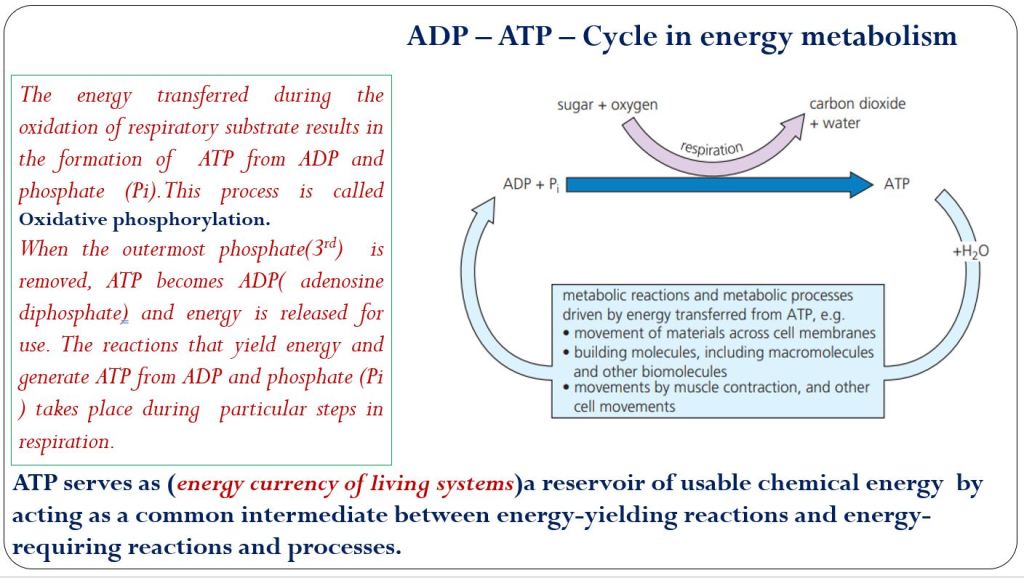
What makes ATP to be the energy currency of cells?
ATP is.
-a substance that moves easily within cells and organisms – by facilitated diffusion.
-formed in cellular respiration and takes part in many reactions of metabolism.
-able to transfer energy in relatively small amounts, sufficient to drive individual reactions.
Applications of Respiration:
✔ Biotechnology – Uses fermentation (beer, bread making).
✔ Exercise Science – Understanding respiration helps improve athletic performance.
✔ Medical Science – Mitochondrial disorders linked to energy metabolism.
✔ Climate Impact – Respiration contributes to CO₂ release in ecosystems.
18. ⚡ Energy & Ecosystems
Energy flows through ecosystems via trophic levels, where organisms transfer energy through feeding relationships (eating and being eaten). At each level, energy is lost due to metabolic processes and energy transformation.
🔹 Energy Transfer in Ecosystems:
✔ Solar Energy → Producers (Plants) – Light energy is converted into chemical energy via photosynthesis.
✔ Producers → Primary Consumers – Herbivores consume plants and gain stored energy.
✔ Primary → Secondary Consumers – Carnivores eat herbivores, transferring energy further.
✔ Decomposers – Break down organic material, recycling nutrients.
🔄 Energy is lost at each trophic level due to respiration, excretion, and heat loss.
Food Chains & Food Webs:
✔ Food Chains – Show linear energy flow (e.g., Grass → Rabbit → Fox).
✔ Food Webs – Complex interconnections among multiple species in an ecosystem.
🔹 Ecological Pyramids:
📊 Pyramid of Numbers – Shows the number of organisms at each level.
📊 Pyramid of Biomass – Represents the total mass of organisms.
📊 Pyramid of Energy – Displays energy flow (always a pyramid shape due to energy loss).
🔹 Gross & Net Primary Productivity (GPP & NPP):
✔ GPP – Total energy absorbed by plants from sunlight.
✔ NPP – Remaining energy after plants use some for respiration (NPP = GPP – Respiration).
✔ Higher NPP = More energy available to consumers.
🔹 Applications
✔ Agriculture – Maximizing NPP for high crop yields.
✔ Conservation – Understanding energy loss helps preserve ecosystems.
✔ Climate Science – Examining energy flow influences sustainability practices.
✔ Food Security – Managing trophic levels ensures efficient food production.
19. Nutrient Cycles [Biogeochemical cycle] 🔄
🌿 Nutrient Cycles
Nutrient cycles describe the movement of essential elements (carbon, nitrogen, phosphorus, etc.) through ecosystems, ensuring their availability for organisms. This flow of matter between the physical environment and living organisms is also described as Biogeochemical cycling.
⚡ Carbon Cycle
🔹 Key Processes:
✔ Photosynthesis – Plants absorb CO₂ to produce organic compounds.
✔ Respiration – Organisms release CO₂ back into the atmosphere.
✔ Decomposition – Microorganisms break down dead matter, returning carbon to the soil.
✔ Combustion – Burning fossil fuels releases CO₂, contributing to climate change.
🔹 Importance:
✔ Supports photosynthesis & energy transfer.
✔ Regulates global climate.
✔ Maintains balance of atmospheric CO₂.
⚡ Nitrogen Cycle
Organisms detect and respond to changes in their environment (stimuli) to ensure survival. This is controlled by the nervous system and endocrine system.
✔ Nitrogen Fixation – Bacteria convert atmospheric N₂ into usable ammonia.
✔ Nitrification – Converts ammonia into nitrates, which plants absorb.
✔ Denitrification – Bacteria return nitrogen gas to the atmosphere.
✔ Decomposition – Dead organisms release ammonia, continuing the cycle.
🔹 Importance:
✔ Essential for protein & DNA synthesis in organisms.
✔ Improves soil fertility for plant growth.
✔ Maintains the concentration of nitrogen depletion in ecosystems.
⚡ Phosphorus Cycle
✔ Weathering – Rocks break down, releasing phosphates into soil.
✔ Absorption – Plants uptake phosphate ions for growth.
✔ Decomposition – Dead organisms return phosphates to soil.
✔ Sedimentation – Phosphorus settles in aquatic ecosystems, forming new rocks.
🔹 Importance:
✔ Essential for ATP & DNA formation.
✔ Involved in bone & cell membrane development.
✔ Supports plant and ecosystem productivity.
🔹 Human Impact on Nutrient Cycles:
❌ Deforestation – Disrupts carbon absorption by trees.
❌ Fertilizers – Excess nitrogen and phosphorus runoff cause eutrophication.
❌ Burning Fossil Fuels – Increases CO₂, affecting climate regulation.
🔹 Significance:
✔ Agriculture – Understanding nutrient cycles improves soil management.
✔ Environmental Conservation – Helps restore ecosystems and reduce pollution.
✔ Climate Science – Regulates greenhouse gases affecting global temperatures.
✔ Waste Management – Supports recycling of nutrients through decomposition.
🌊20. Eutrophication and Biomagnification
Both eutrophication and biomagnification threaten ecosystems, biodiversity, and human health. Addressing them requires global collaboration in environmental policies, sustainable development, and conservation efforts.
Eutrophication:
Eutrophication refers to the excessive enrichment of water bodies with nutrients (mainly nitrogen and phosphorus), leading to algal blooms and disrupted ecosystems.
🔹 Causes of Eutrophication:
✔ Agricultural Runoff – Fertilizers containing nitrates and phosphates wash into lakes and rivers.
✔ Industrial & Domestic Waste – Sewage and factory effluents increase nutrient levels in water.
✔ Deforestation – Loss of vegetation reduces soil absorption of excess nutrients.
✔ Atmospheric Deposition – Pollutants in the air settle into water bodies, adding nutrients.
🔹 Consequences of Eutrophication:
❌ Algal Blooms – Rapid algal growth blocks sunlight, affecting aquatic life.
❌ Hypoxia (Low Oxygen Levels) – Decomposing algae consume oxygen, leading to dead zones.
Increased (BOD) Biochemical Oxygen Demand
❌ Loss of Biodiversity – Fish and aquatic organisms suffocate and die due to oxygen depletion.
❌ Contaminated Drinking Water – Excess nitrates make water unsafe for human consumption.
🔹 Mitigation Strategies for Eutrophication:
✔ Reducing Fertilizer Use – Applying controlled amounts of fertilizers prevents excess runoff.
✔ Wastewater Treatment – Removing nutrients from sewage before discharge into water bodies.
✔ Buffer Zones – Planting vegetation near water absorbs excess nutrients before they enter lakes.
✔ Public Awareness & Policies – Enforcing environmental laws limits pollution and promotes sustainable practices.
🔗 Biomagnification
Biomagnification is the progressive increase in the concentration of non-biodegradable toxic substances such as pesticides, heavy metals, etc. as they move up the food chain.
🔹 Causes of Biomagnification:
✔ Pesticide Use – Chemicals like DDT accumulate in organisms and become more concentrated.
✔ Industrial Pollution – Heavy metals (mercury, lead) enter water and soil, affecting food chains.
✔ Oil Spills – Contaminants in oceans affect marine ecosystems.
✔ Plastic Waste & Microplastics – Absorbed by small organisms and passed to predators.
🔹 Consequences of Biomagnification:
❌ Health Hazards in Humans – Toxins can cause cancer, neurological disorders, and organ damage.
❌ Decline in Predator Species – Apex predators accumulate the highest toxin levels, leading to population decline.
❌ Disruption of Food Webs – Contaminated organisms affect ecosystem balance.
❌ Bioaccumulation in Water Sources – Pollutants remain in aquatic environments for decades.
🔹 Mitigation Strategies for Biomagnification:
✔ Banning Harmful Chemicals – Restricting substances like DDT and mercury limits toxin buildup.
✔ Eco-Friendly Agriculture – Using biodegradable pesticides reduces accumulation.
✔ Proper Waste Disposal – Preventing industrial pollutants from entering water systems.
✔ Public Awareness & Conservation – Educating communities about sustainable practices and ecosystem health.

 Explore the World of Life Sciences