Science is also a style of thinking and doing things besides being the organized body of knowledge gathered through experimentation and critical and methodical observations!
“I have not failed. I’ve just found 10,000 ways that won’t work.” — Thomas A. Edison
“The important thing is not to stop questioning. Curiosity has its own reason for existence.” — Albert Einstein.
Being a student of science should always remember that: while you are doing science, something somewhere is waiting to be explored/discovered/unearthed!
What does doing an investigatory project in science mean?
An Investigatory Project is a research-based scientific study where students apply the Scientific Method to uncover answers to questions they have about the world around them. An investigatory project in science is neither just a demonstration or a model nor mere collection of information ; But it is an original experiment designed to test a specific hypothesis.
Here are the phases of an investigatory project,outlined step-by-step for you!
Phase 1: Planning and Conceptualization
1. Choosing a Topic
The best projects come from genuine curiosity. Encourage students to look around their daily lives, hobbies, or community for inspiration.
- Observe: What problems need solving? What phenomena make you ask “why” or “how”?
- Keep it feasible: Ensure the project can be completed with available resources, time, and budget.
- Ensure it is testable: A good topic must be framed as a question that can be answered through experimentation (e.g., “How does the pH level of soil affect the growth rate of tomato plants?”).
2. Background Research [Literature review]
Before jumping into the experiment, students must understand what is already known about their topic.
- Read books, scientific journals, and credible websites.
- Understand the underlying scientific principles.
- Trainer Tip: Require students to maintain a “Research Log” to record their sources for the bibliography early on.
3. Formulating the Hypothesis
A hypothesis is an educated guess based on background research. It should predict the relationship between variables.
- Format: “If [I do this], then [this will happen], because [scientific reasoning].”
- Example: “If the soil pH is highly acidic, then the tomato plants will grow slower than in neutral soil, because high acidity hinders nutrient absorption.”
Phase 2: Experimental Design:
An experiment must be carefully structured to ensure the results are valid and reliable. Teach students to identify their variables clearly:
- Independent Variable: The one factor the student changes or manipulates. (e.g., The pH level of the water).
- Dependent Variable: The factor the student measures to see if it responds to the change. (e.g., The height of the plants).
- Controlled Variables (Constants): Everything else that must be kept the same to ensure a fair test. (e.g., Amount of sunlight, volume of water, type of soil, type of seed).
Writing the Procedure:
The procedure must be written like a detailed recipe. Another scientist should be able to read it and replicate the experiment exactly.
- List all materials with precise quantities.
- Number the steps sequentially.
- Include multiple trials (at least 3) to ensure results are not flukes.
Phase 3: Execution and Data Collection
- Maintain a Project Logbook: This is the most crucial piece of evidence. Students should record dates, observations, raw data, mistakes, and changes made during the experiment.
- Organize Data: Use tables to record data clearly as it is collected.
- Take Photos: Visual evidence of the setup, process, and results is vital for the final report.
Phase 4: Drafting the Final Report
This is the formal document where students communicate their journey and findings. The report should be written in the third person, using clear, objective language.
Here is the standard structure students must follow:
1. Title Page
- Title of the project (Catchy but descriptive)
- Student’s name, grade, and school
- Date of submission
2. Abstract
- A short, maximum 250-word summary of the entire project. It should briefly state the problem, methodology, major findings, and conclusion. (Write this last).
3. Introduction
- Background information on the topic.
- The Statement of the Problem / Research Question.
- The Hypothesis.
- The Significance of the Study (Why does this research matter? Who benefits from it?).
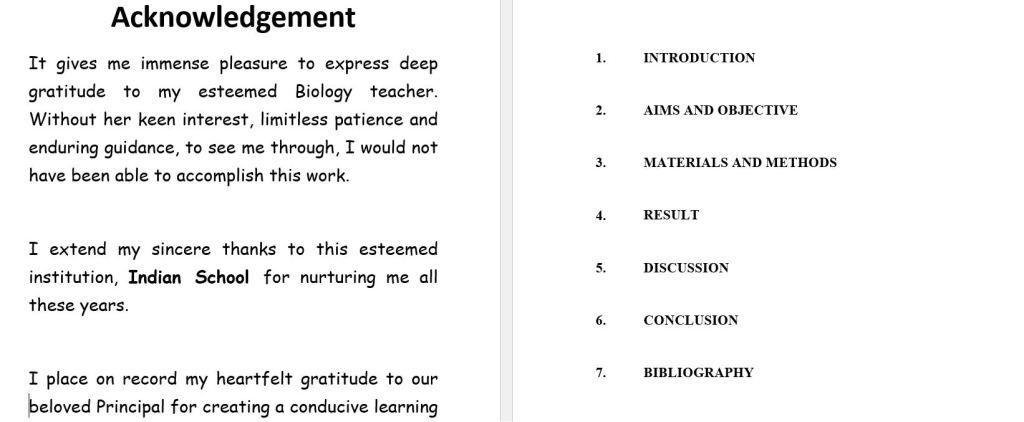
4. Materials and Methods
- Materials: A bulleted, exhaustive list of items used.
- Procedure: A numbered, step-by-step description of how the experiment was conducted.
5. Results
- Present data using visually appealing formats.
- Use Tables, Bar Graphs, Line Graphs, or Pie Charts depending on the type of data.
- Add short descriptive text under each graph explaining what the data shows (do not interpret why it happened yet, just state what the data is).
6. Discussion / Analysis
- This is where students interpret the data.
- Are there any patterns or trends?
- Were there any anomalies or unexpected results?
- What scientific principles explain these results?
7. Conclusion
- Answer the original research question.
- State clearly whether the data supported or rejected the hypothesis. (Remind students that a rejected hypothesis is still good science!).
8. Recommendations
- How could the experiment be improved if done again? (e.g., controlling a variable better, testing a wider range).
- What future studies could branch off from this project?
9. Bibliography / References
- A properly formatted list of all books, articles, and websites used during the research phase.
Example:
- Jackson Achankunju and S. Daniel, Emerging Challenges in Biopigments Food Applications, Emerging Challenges in Agriculture and Food Science vol.8, ISBN:978-81-19217-36-6, E ISBN:978-81-19217-38-0.
- Ira Rai, Jackson Achankunju and Vandana Vinayak, Terraforming Mars with Microalgae Especially Diatoms, Diatom Cultivation for Biofuel, Food and High-Value Products, vol.1, ISBN: 9781394174485, Scrivener and WILEY, pp: 315-336, (2025).
<!DOCTYPE html><html lang="en"><head> <meta charset="UTF-8"> <meta name="viewport" content="width=device-width, initial-scale=1.0"> <title>Unit VI: Reproduction | Learn Bio with Dr. Jackson</title> <style> :root { --bg-light: #f8fafc; --nav-dark: #0f172a; --text-main: #334155; /* Multi-color Palette for Chapters */ --ch1-color: #ff4757; /* Bright Rose for Flowering Plants */ --ch2-color: #2e86de; /* Royal Blue for Human Reproduction */ --ch3-color: #20bf6b; /* Emerald Green for Reproductive Health */ } body { font-family: 'Segoe UI', Tahoma, Geneva, Verdana, sans-serif; background-color: var(--bg-light); color: var(--text-main); margin: 0; padding: 0; } /* Top Brand Header */ .brand-bar { background-color: var(--nav-dark); color: white; padding: 15px 20px; display: flex; justify-content: space-between; align-items: center; } .brand-bar a { color: #ff9f43; text-decoration: none; font-weight: bold; } /* Unit Banner */ .unit-banner { background: linear-gradient(135deg, #ff4757 0%, #ff6b81 100%); color: white; text-align: center; padding: 50px 20px; box-shadow: 0 4px 15px rgba(0,0,0,0.1); } .unit-banner h1 { margin: 0; font-size: 2.5rem; } .unit-banner p { margin: 10px 0 0 0; font-size: 1.2rem; opacity: 0.9; } /* Container Grid */ .main-container { max-width: 1200px; margin: 40px auto; padding: 0 20px; } .chapter-section { background: white; border-radius: 16px; margin-bottom: 40px; box-shadow: 0 10px 25px rgba(0,0,0,0.05); overflow: hidden; border-top: 8px solid; transition: transform 0.3s; } .chapter-section:hover { transform: translateY(-2px); } /* Color variations for chapters */ .ch-1 { border-top-color: var(--ch1-color); } .ch-2 { border-top-color: var(--ch2-color); } .ch-3 { border-top-color: var(--ch3-color); } .ch-header { padding: 25px 30px; color: white; display: flex; justify-content: space-between; align-items: center; } .ch-1 .ch-header { background: linear-gradient(135deg, #ff4757, #ff6b81); } .ch-2 .ch-header { background: linear-gradient(135deg, #2e86de, #54a0ff); } .ch-3 .ch-header { background: linear-gradient(135deg, #20bf6b, #05c46b); } .ch-header h2 { margin: 0; font-size: 1.6rem; } .badge { background: rgba(255, 255, 255, 0.2); padding: 6px 12px; border-radius: 20px; font-size: 0.85rem; font-weight: bold; } .ch-body { padding: 30px; } .topic-grid { display: grid; grid-template-columns: repeat(auto-fit, minmax(280px, 1fr)); gap: 20px; margin-top: 15px; } .topic-card { background: #f8fafc; border: 1px solid #e2e8f0; border-radius: 10px; padding: 20px; transition: background 0.3s; } .topic-card h3 { margin-top: 0; font-size: 1.1rem; display: flex; align-items: center; gap: 8px; } .ch-1 .topic-card h3 { color: var(--ch1-color); } .ch-2 .topic-card h3 { color: var(--ch2-color); } .ch-3 .topic-card h3 { color: var(--ch3-color); } .topic-card p { margin: 0; font-size: 0.95rem; line-height: 1.5; color: #475569; } /* Action Buttons */ .btn-group { margin-top: 25px; display: flex; gap: 15px; flex-wrap: wrap; } .btn { padding: 10px 20px; border-radius: 8px; text-decoration: none; font-weight: bold; font-size: 0.95rem; transition: opacity 0.3s; color: white; } .btn:hover { opacity: 0.9; } .ch-1 .btn { background-color: var(--ch1-color); } .ch-2 .btn { background-color: var(--ch2-color); } .ch-3 .btn { background-color: var(--ch3-color); } .btn-alt { background-color: transparent !important; border: 2px solid; } .ch-1 .btn-alt { color: var(--ch1-color); border-color: var(--ch1-color); } .ch-2 .btn-alt { color: var(--ch2-color); border-color: var(--ch2-color); } .ch-3 .btn-alt { color: var(--ch3-color); border-color: var(--ch3-color); } footer { background-color: var(--nav-dark); color: white; text-align: center; padding: 20px; margin-top: 60px; } </style></head><body> <div class="brand-bar"> <span>learbiowithdr.jackson.com</span> <a href="#">← Back to Dashboard</a> </div> <div class="unit-banner"> <h1>UNIT-VI: REPRODUCTION</h1> <p>Comprehensive CBSE Class 12 Study Modules</p> </div> <div class="main-container"> <!-- CHAPTER 1 --> <div class="chapter-section ch-1"> <div class="ch-header"> <h2>Chapter-1: Sexual Reproduction in Flowering Plants</h2> <span class="badge">Topic Module 01</span> </div> <div class="ch-body"> <div class="topic-grid"> <div class="topic-card"> <h3>🌸 Anatomy & Gametes</h3> <p>Flower structure; deep-dive development of male and female gametophytes.</p> </div> <div class="topic-card"> <h3>🐝 Pollination Dynamics</h3> <p>Types, environmental/biological agencies, explicit examples, and outbreeding devices.</p> </div> <div class="topic-card"> <h3>🧪 Fertilization</h3> <p>Pollen-pistil interaction mechanics and the dual process of Double Fertilization.</p> </div> <div class="topic-card"> <h3>🌱 Post-Fertilization</h3> <p>Development of endosperm & embryo, seed structures, fruit formation, and special modes (Apomixis, Parthenocarpy, Polyembryony).</p> </div> </div> <div class="btn-group"> <a href="#" class="btn">Start Learning Notes</a> <a href="#" class="btn btn-alt">Interactive Quiz</a> </div> </div> </div> <!-- CHAPTER 2 --> <div class="chapter-section ch-2"> <div class="ch-header"> <h2>Chapter-2: Human Reproduction</h2> <span class="badge">Topic Module 02</span> </div> <div class="ch-body"> <div class="topic-grid"> <div class="topic-card"> <h3>🔬 Structural Anatomy</h3> <p>Male and female reproductive systems along with microscopic anatomy of the testis and ovary.</p> </div> <div class="topic-card"> <h3>🔄 Gametogenesis & Cycle</h3> <p>Step-by-step processes of Spermatogenesis, Oogenesis, and hormonal changes during the Menstrual Cycle.</p> </div> <div class="topic-card"> <h3>⚡ Embryology</h3> <p>Fertilisation paths, embryo progression up to blastocyst stage, and implantation processes.</p> </div> <div class="topic-card"> <h3>👶 Pregnancy & Beyond</h3> <p>Placenta formation framework, basic elements of Pregnancy, Parturition, and Lactation physiology.</p> </div> </div> <div class="btn-group"> <a href="#" class="btn">Start Learning Notes</a> <a href="#" class="btn btn-alt">Interactive Quiz</a> </div> </div> </div> <!-- CHAPTER 3 --> <div class="chapter-section ch-3"> <div class="ch-header"> <h2>Chapter-3: Reproductive Health</h2> <span class="badge">Topic Module 03</span> </div> <div class="ch-body"> <div class="topic-grid"> <div class="topic-card"> <h3>🛡️ Prevention & Care</h3> <p>Need for reproductive health maintenance and safety tracking against Sexually Transmitted Diseases (STDs).</p> </div> <div class="topic-card"> <h3>🛑 Family Planning</h3> <p>Birth control needs, comprehensive contraceptive methods, and Medical Termination of Pregnancy (MTP) laws/guidance.</p> </div> <div class="topic-card"> <h3>🧬 Clinical Diagnostics</h3> <p>Amniocentesis screening values, core causes behind infertility, and diagnostic boundaries.</p> </div> <div class="topic-card"> <h3>🔬 Medical ART</h3> <p>Elementary exploration of Assisted Reproductive Technologies including IVF, ZIFT, and GIFT systems.</p> </div> </div> <div class="btn-group"> <a href="#" class="btn">Start Learning Notes</a> <a href="#" class="btn btn-alt">Interactive Quiz</a> </div> </div> </div> </div> <footer> <p>© 2026 learbiowithdr.jackson.com | Class 12 CBSE Biology Guide</p> </footer></body></html>